Transpose Prescription Formula: Step-by-Step Guide
Master the transposition formula and convert prescriptions between plus-cylinder and minus-cylinder formats with confidence.
The Bottom Line
Prescription transposition converts a prescription from one equivalent format to another using a simple three-step formula: add sphere and cylinder for the new sphere, negate the cylinder, and rotate the axis by 90°. The transposed prescription is optically identical to the original—only the format changes. This core skill appears on 10-15% of ABO exams and is essential for lens manufacturing decisions.
What Is Prescription Transposition?
Prescription transposition is the process of converting an eyeglass prescription from one equivalent form to another. While it sounds complicated, transposition simply rearranges the same optical information into a different format—similar to how you can write 1/2 or 0.5 to mean the same value.
The most common transposition converts between plus-cylinder format (where the cylinder is positive) and minus-cylinder format (where the cylinder is negative). Both formats provide identical optical correction for the patient, but they're specified differently.
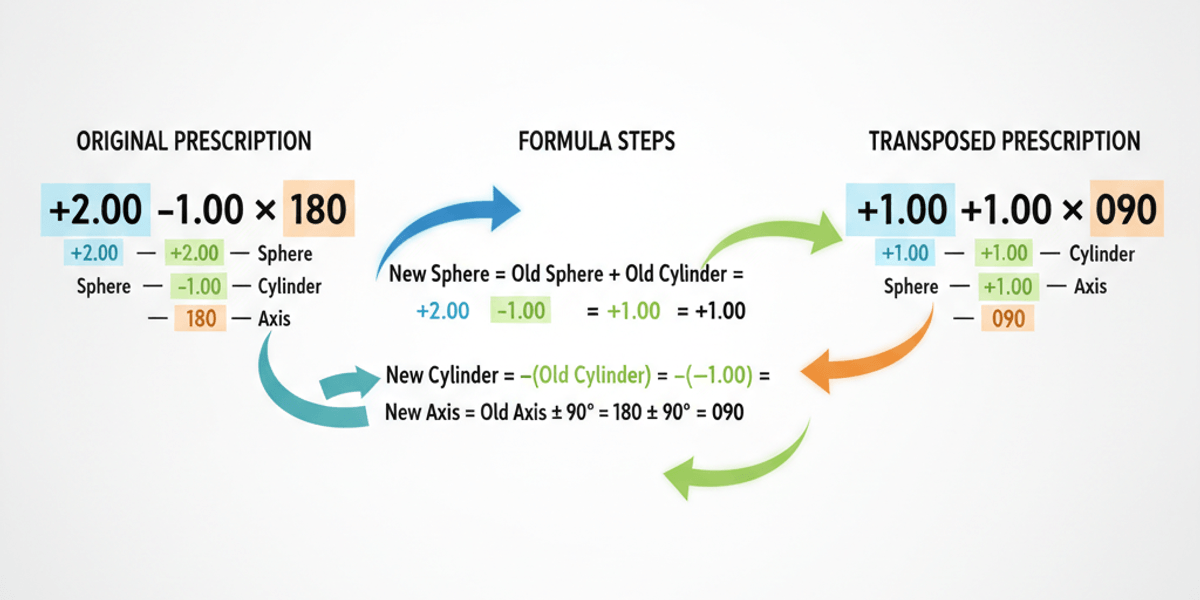
For example, these two prescriptions are optically equivalent:
+2.00 −1.00 × 180
is the same as
+1.00 +1.00 × 090
A patient wearing either of these prescriptions would see identically. The difference is purely how the lens maker receives and manufactures the order.
Why Transposition Matters in Optics
Lens Material Compatibility
Some lens materials (like CR-39 plastic or high-index) are more efficiently manufactured in minus-cylinder form, while others work better in plus-cylinder. Transposition allows the optician to specify the prescription in the optimal format.
Laboratory Communication
Different laboratories and lens manufacturers may request prescriptions in specific formats. Transposition ensures seamless communication without changing the optical result.
Exam Verification
The ABO and NCLE exams test transposition as a core optician calculation skill. Mastering it is non-negotiable for certification success.
Double-Checking Calculations
Transposing a prescription forward and backward is a powerful way to verify mathematical accuracy and catch errors in other optical calculations.
The Transposition Formula
Transposition follows a straightforward three-step process:
Transposition Formula
Step 1: New Sphere = Old Sphere + Old Cylinder
Step 2: New Cylinder = −(Old Cylinder)
Step 3: New Axis = Old Axis ± 90°
Let's break down what each step means:
Step 1: Add Sphere and Cylinder
The new sphere power becomes the sum of the old sphere and old cylinder. Always perform this addition carefully, watching for signs (+/−).
Example: Old Sphere +2.00, Old Cylinder −1.00 → New Sphere = +2.00 + (−1.00) = +1.00
Step 2: Negate the Cylinder
The new cylinder power is the negative of the old cylinder. A minus becomes plus, and a plus becomes minus. The magnitude (absolute value) stays the same.
Example: Old Cylinder −1.00 → New Cylinder = −(−1.00) = +1.00
Step 3: Rotate Axis by 90°
The new axis is always 90 degrees away from the old axis. If old axis is 180°, new is 090°. If old is 045°, new is 135°. Axes range from 1° to 180°, so after adding or subtracting 90°, adjust if needed to stay in range.
Example: Old Axis 180° → New Axis = 180° − 90° = 090°
Step-by-Step Transposition Examples
Example 1: Simple Minus-Cylinder to Plus-Cylinder
Original Prescription (Minus-Cylinder):
+2.00 −1.00 × 180
Step 1: New Sphere
New Sphere = +2.00 + (−1.00) = +1.00
Step 2: New Cylinder
New Cylinder = −(−1.00) = +1.00
Step 3: New Axis
New Axis = 180° − 90° = 090°
Transposed Prescription (Plus-Cylinder):
+1.00 +1.00 × 090
Both +2.00 −1.00 × 180 and +1.00 +1.00 × 090 are optically identical. The patient sees the same correction either way.
Example 2: Negative Sphere with Minus-Cylinder
Original Prescription:
−3.50 −0.75 × 045
Step 1: New Sphere
New Sphere = −3.50 + (−0.75) = −4.25
Step 2: New Cylinder
New Cylinder = −(−0.75) = +0.75
Step 3: New Axis
New Axis = 045° + 90° = 135°
Transposed Prescription:
−4.25 +0.75 × 135
Notice that when the old sphere is negative and you add a negative cylinder, the result becomes more negative. This is correct.
Example 3: Sphere-Only Prescription
Original Prescription:
+1.50 DS
Step 1: New Sphere
New Sphere = +1.50 + 0 = +1.50 (no cylinder to add)
Step 2: New Cylinder
New Cylinder = 0 (sphere only, so cylinder is always zero)
Transposed Prescription:
+1.50 DS (no change)
A sphere-only prescription cannot be transposed—it remains the same in any format. Transposition only applies to prescriptions with cylinder.
Example 4: Plus-Cylinder to Minus-Cylinder
Original Prescription (Plus-Cylinder):
+0.50 +2.00 × 120
Step 1: New Sphere
New Sphere = +0.50 + (+2.00) = +2.50
Step 2: New Cylinder
New Cylinder = −(+2.00) = −2.00
Step 3: New Axis
New Axis = 120° + 90° = 210° → adjust to 030° (subtract 180 to stay in range)
Transposed Prescription (Minus-Cylinder):
+2.50 −2.00 × 030
Remember: axes range from 1° to 180°. If your new axis exceeds 180°, subtract 180° to bring it back into range.
Key Rules for Axis Rotation
Rule 1: Axes Range 1° to 180°
Axis values never go above 180°. If adding 90° results in 210°, subtract 180° to get 030°. Conversely, if subtracting 90° would give a negative number, add 180°.
Rule 2: Always Rotate Exactly 90°
Add 90° or subtract 90°—no other number. This perpendicular rotation is essential to maintaining the correct optical properties.
Rule 3: When in Doubt, Verify
Transpose the result back to the original format. If you get the same prescription, you did it correctly. This double-check catches errors immediately.
Axis Conversion Quick Reference:
- • 000° + 90° = 090° (or add as 0° + 90° = 90°)
- • 045° + 90° = 135°
- • 090° + 90° = 180°
- • 135° + 90° = 225° → adjust to 045° (225 − 180)
- • 180° − 90° = 090°
Common Mistakes in Transposition
Forgetting to Add Sphere and Cylinder
The most common mistake is writing the sphere value incorrectly. You MUST add the cylinder to the sphere in Step 1. Don't just flip signs without adding.
Incorrectly Rotating the Axis
Always rotate exactly 90°. Common errors include rotating 45°, forgetting to adjust when exceeding 180°, or rotating in the wrong direction. Check your axis carefully.
Negating the Cylinder Incorrectly
Negation is straightforward (−1.00 becomes +1.00), but errors happen with compound mistakes. Separate this step from the addition in Step 1 to reduce errors.
Not Verifying Your Work
Transpose the result back to the original. If you don't get the original prescription, you made an error. This verification step catches 95% of mistakes immediately.
Confusing Addition and Negation
Step 1 is addition (sphere + cylinder). Step 2 is negation (flip the sign). These are separate operations—don't combine them or you'll get wrong results.
Transposition vs. Other Optical Concepts
Transposition is sometimes confused with other optical calculations. Here's how it differs:
Transposition
Rearranges the same optical power into a different format
+2.00 −1.00 × 180 ↔ +1.00 +1.00 × 090
Patient sees identically
Spherical Equivalent
Approximates total power as a single sphere value
+2.00 −1.00 × 180 ≈ +1.50 DS
Patient sees approximately—cylinder is lost
The key difference: transposition preserves all optical information in a new format, while spherical equivalent approximates by discarding cylinder information.
Practice Problems
Problem 1:
Transpose: +3.00 −1.50 × 090
Show Answer
New Sphere: +3.00 + (−1.50) = +1.50
New Cylinder: −(−1.50) = +1.50
New Axis: 090° + 90° = 180°
Answer: +1.50 +1.50 × 180
Problem 2:
Transpose: −2.00 −0.50 × 045
Show Answer
New Sphere: −2.00 + (−0.50) = −2.50
New Cylinder: −(−0.50) = +0.50
New Axis: 045° + 90° = 135°
Answer: −2.50 +0.50 × 135
Problem 3:
Transpose: +1.00 +1.00 × 135, then verify by transposing the result back to the original.
Show Answer
Transposition 1:
New Sphere: +1.00 + (+1.00) = +2.00
New Cylinder: −(+1.00) = −1.00
New Axis: 135° − 90° = 045°
Result: +2.00 −1.00 × 045
Verify (transpose back):
New Sphere: +2.00 + (−1.00) = +1.00
New Cylinder: −(−1.00) = +1.00
New Axis: 045° + 90° = 135°
Verified: +1.00 +1.00 × 135 ✓
Problem 4:
Transpose: −4.50 +2.00 × 180
Show Answer
New Sphere: −4.50 + (+2.00) = −2.50
New Cylinder: −(+2.00) = −2.00
New Axis: 180° + 90° = 270° → adjust to 090° (270 − 180)
Answer: −2.50 −2.00 × 090
Try these without looking at answers first. Use our transposition calculator to verify your work.
Master Optical Mathematics
Transposition is one of three core optical math skills. Master transposition, prism calculation, and spherical equivalent to dominate the math section of your ABO exam.
View ABO Study GuideFrequently Asked Questions
What is prescription transposition?
Prescription transposition is converting a prescription from one equivalent form to another. The most common transposition converts between plus-cylinder and minus-cylinder formats, where the optical effect remains identical but the sphere and cylinder values change. For example, +2.00 -1.00 x 180 is equivalent to +1.00 +1.00 x 090.
Why do opticians need to transpose prescriptions?
Some lenses are naturally ground in minus-cylinder form (CR-39, high-index), while others are better made in plus-cylinder form. Transposition allows the optician to convert the prescription to the most appropriate form for the lens material and patient needs while maintaining the exact optical correction.
What is the transposition formula?
The transposition formula is: New Sphere = Old Sphere + Old Cylinder; New Cylinder = −(Old Cylinder); New Axis = Old Axis ± 90°. This creates an equivalent prescription with reversed cylinder sign and rotated axis, but the same optical power at all meridians.
Is the transposed prescription the same as the original?
Yes, the transposed prescription is optically identical to the original. Both versions provide the same correction for the patient's vision. The only difference is which meridian (axis) is labeled as the sphere and which as the cylinder. The resulting glasses will have identical optical properties.
How often is transposition tested on the ABO exam?
Transposition appears on approximately 10-15% of ABO exam questions. It's a core mathematical skill that may be tested directly (transpose this prescription) or indirectly (calculate power at an axis for a transposed prescription).