How to Calculate Prism: Step-by-Step Formula & Examples
Master Prentice's Rule and prism calculation. Essential for ABO and NCLE certification.
The Bottom Line
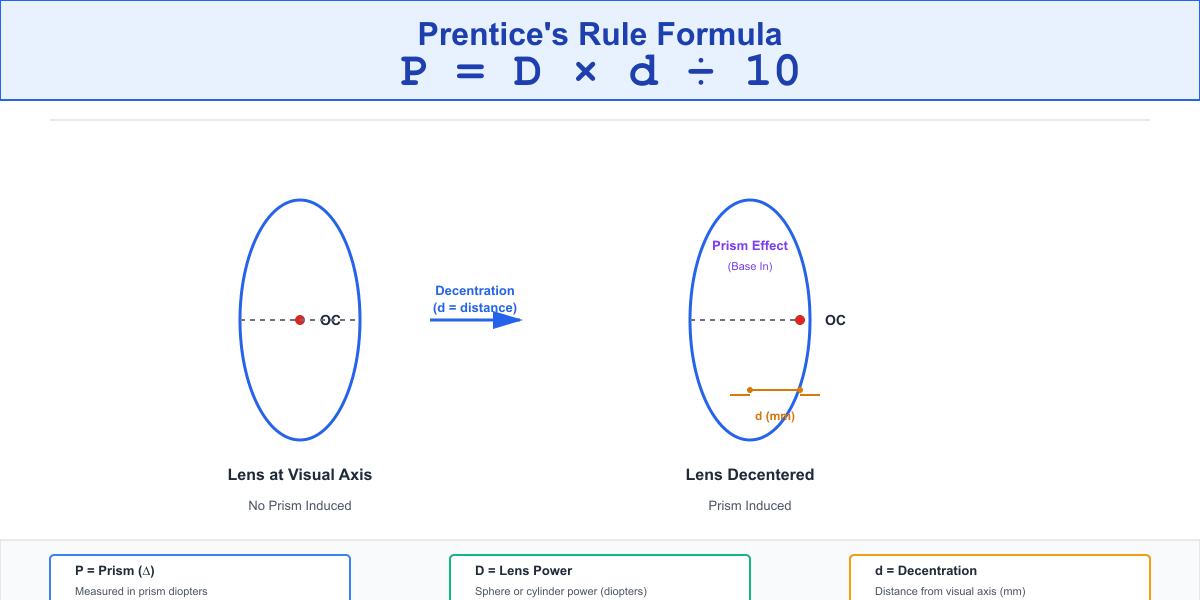
Prism is calculated using Prentice's Rule: P = D × d ÷ 10, where D is lens power and d is decentration in millimeters. This single formula is the foundation of optical mathematics and appears on virtually every ABO and NCLE exam. Master this, and you unlock one of the most testable topics in optician certification.
What Is Prism and Why Does It Matter?
Prism is a lens element that bends light toward its base. Measured in diopters (∆), prism is used to correct eye misalignments (strabismus, phorias) or correct for prismatic effects created when lens optical centers are positioned away from the visual axis.
Understanding prism calculation matters because:
- Exam coverage: Prism questions appear on 20-30% of ABO tests and 15-20% of NCLE exams
- Patient care: Precise prism calculations prevent patient discomfort, double vision, and lens returns
- Practice workflow: Prism calculations determine fitting heights, decentration limits, and lens positioning
Prentice's Rule: The Core Formula
Prism (∆) = Lens Power (D) × Decentration (d in mm) ÷ 10
P = D × d ÷ 10
Let's break down each component:
P (Prism in Diopters)
The result you're solving for. Prism diopters measure the amount of light deviation. One prism diopter deviates light 1 cm at 1 meter distance.
D (Lens Power in Diopters)
The refractive power of the lens where decentration occurs. Use sphere power for horizontal decentration, or cylinder power for decentration along the cylinder axis. Sign matters, but so does decentration direction: for temporal decentration, positive power creates base out and negative creates base in (it reverses for nasal decentration — see the rules below).
d (Decentration in Millimeters)
The distance the optical center moves from the visual axis, measured in mm. Can be horizontal (in/out) or vertical (up/down). The formula is the same; direction is determined separately.
The "÷ 10" factor is a unit conversion constant. It accounts for the relationship between diopter measurements and physical distances in typical lens-wearing conditions.
Step-by-Step Calculation Examples
Example 1: Basic Horizontal Decentration
Scenario: Prescription +3.00 D sphere, optical center decentered 5 mm temporally
Given:
- • D = +3.00
- • d = 5 mm
Calculation:
P = 3.00 × 5 ÷ 10 = 1.5 Δ
Result: 1.5 prism diopters base out (temporal)
Why base out? With positive power, the prism base forms in the same direction the optical center is decentered — here, temporally, so the base is temporal (out).
Example 2: Cylinder Power and Vertical Decentration
Scenario: Progressive lens fitting, cyl -1.50 × 180°, fitting height 2 mm too high (vertical decentration 2 mm up)
Given:
- • D = -1.50 (cylinder power along 180° axis)
- • d = 2 mm (vertical)
Calculation:
P = -1.50 × 2 ÷ 10 = -0.30 Δ
Result: 0.30 prism diopters base down (vertical)
The negative sign indicates base down. When fitting height is too high, induced prism shifts base down, which can cause vertical imbalance or eye strain if not corrected.
Example 3: Solving for Decentration
Scenario: You need 2 Δ base out for a corrective lens. Lens power is +4.00. How much should you decenter the optical center?
Given:
- • P = 2 Δ (desired prism)
- • D = +4.00
- • d = ? (solve for this)
Rearranged Formula:
d = P × 10 ÷ D = 2 × 10 ÷ 4.00 = 5 mm
Result: Decenter the optical center 5 mm temporally
This rearrangement is tested frequently. You'll see: "A patient needs 2 Δ base out. The lens is +4.00. What decentration is required?" Master the algebra to flip the formula.
Prism Direction: Base Rules
Calculating the magnitude is only half the battle. You must also determine prism direction correctly.
Rule 1: Positive Power
With positive (plus) power, decentration creates prism with base pointing toward the optical center. If OC moves nasally (in), base points nasally. If OC moves temporally (out), base points temporally.
Rule 2: Negative Power
With negative (minus) power, decentration creates prism with base pointing away from the optical center. If OC moves nasally (in), base points temporally (out). If OC moves temporally (out), base points nasally (in).
Quick Memory Aid: "Base Apex"
The apex (thin edge) of a prism always points toward the optical center for minus lenses, and away for plus lenses. The base (thick edge) points the opposite direction. This visual trick helps when you're stuck.
Common Exam Mistakes & How to Avoid Them
Forgetting the ÷ 10
Many test-takers calculate D × d and forget to divide by 10, getting answers that are 10× too large. Always include the ÷ 10. Write it out: P = D × d ÷ 10.
Mixing Up Power Types
Use sphere power for horizontal decentration, cylinder power for decentration along the cylinder axis. Using the wrong power value breaks the entire calculation.
Ignoring Sign (+ vs −)
The sign of the power matters. It determines whether base points toward or away from the OC. A -2.00 lens behaves opposite to a +2.00 lens. Always track the sign.
Forgetting Units (mm vs cm)
Decentration is always measured in millimeters in the formula. If given in centimeters, convert first (cm × 10 = mm). Using 5 instead of 50 mm will off your answer by a factor of 10.
Induced vs. Prescribed Prism
Induced Prism
A side effect of lens decentration. Occurs when optical center isn't at the visual axis.
Calculated using:
P = D × d ÷ 10
Usually unwanted. Must minimize or correct.
Prescribed Prism
Intentionally ground into the lens to correct eye misalignment (strabismus, phoria).
Added to the prescription:
+1.50 DS 2Δ BO
Purposeful. Ordered for patient benefit.
On exams: You may be asked to calculate total prism at a point in a lens with both prescribed and induced prism. Add them together (with signs). If a lens has 2Δ BO prescribed and creates 0.5Δ BI induced, total = 2 − 0.5 = 1.5Δ BO.
Practice Problems to Try
Problem 1:
A +2.50 D lens is decentered 6 mm nasally. How much prism is induced and in what direction?
Show Answer
P = 2.50 × 6 ÷ 10 = 1.5Δ base nasal (base in)
Problem 2:
A −3.00 D lens requires 1.2 prism diopters base in. How much decentration is needed?
Show Answer
d = 1.2 × 10 ÷ 3.00 = 4 mm temporal (for negative power, base in = temporal decentration)
Problem 3:
Calculate the total prism at a point 8 mm nasal in a +3.00 lens that has 1Δ BO prescribed.
Show Answer
Induced: 3.00 × 8 ÷ 10 = 2.4Δ BO; Total = 1Δ BO + 2.4Δ BO = 3.4Δ BO
Try calculating these without looking at answers first. Use our prism calculator to verify your work.
Master Optical Math
Prism calculation is just one piece of optical mathematics. Our comprehensive study materials cover Prentice's Rule, transposition, vertex distance, and all formulas you need for exam day.
View ABO Study GuideFrequently Asked Questions
What is Prentice's Rule?
Prentice's Rule is the fundamental formula for calculating induced prism: P = D × d ÷ 10, where P is prism diopters, D is lens power (sphere or cylinder), and d is decentration distance in millimeters. It's the most important formula for ABO and NCLE exam success.
When do you need to calculate prism?
You calculate prism when the optical center of a lens is displaced from the patient's visual axis. This occurs when fitting multifocal lenses, high prescriptions, large frame sizes, or when correcting horizontal or vertical eye misalignment (strabismus or phoria).
How do you determine prism direction?
Prism direction depends on both the power sign and the decentration direction. For a plus (positive) lens, the base points in the same direction as the decentration — for example, decenter the optical center temporally and the base points temporally (out). For a minus (negative) lens, it's the opposite: decenter temporally and the base points nasally (in).
What's the difference between induced prism and prescribed prism?
Prescribed prism is intentionally ordered on the lens to correct eye misalignment. Induced prism is an unwanted side effect from lens decentration during fitting. Understanding both is crucial for determining total prism at any point in a lens.