Contact Lens Fitting Guide: Materials, Fit Assessment & Troubleshooting
Learn how to fit contact lenses as an optician: assess the eye, select appropriate lens designs and materials, evaluate on-eye fit, and troubleshoot common issues safely.
Key Takeaways
- A fitting starts with ocular health, tear film, refraction, corneal measurements, and the patient's visual needs.
- Soft-lens fit depends on sagittal depth; assess centration, coverage, movement, push-up, vision, and tissue response together.
- Evaluate RGP lenses with fluorescein to judge the relationship between the back surface and the cornea.
- For toric lenses, allow settling and use LARS: Left Add, Right Subtract for axis compensation.
- Pain, photophobia, marked redness, discharge, or reduced vision require lens removal and prompt professional evaluation.
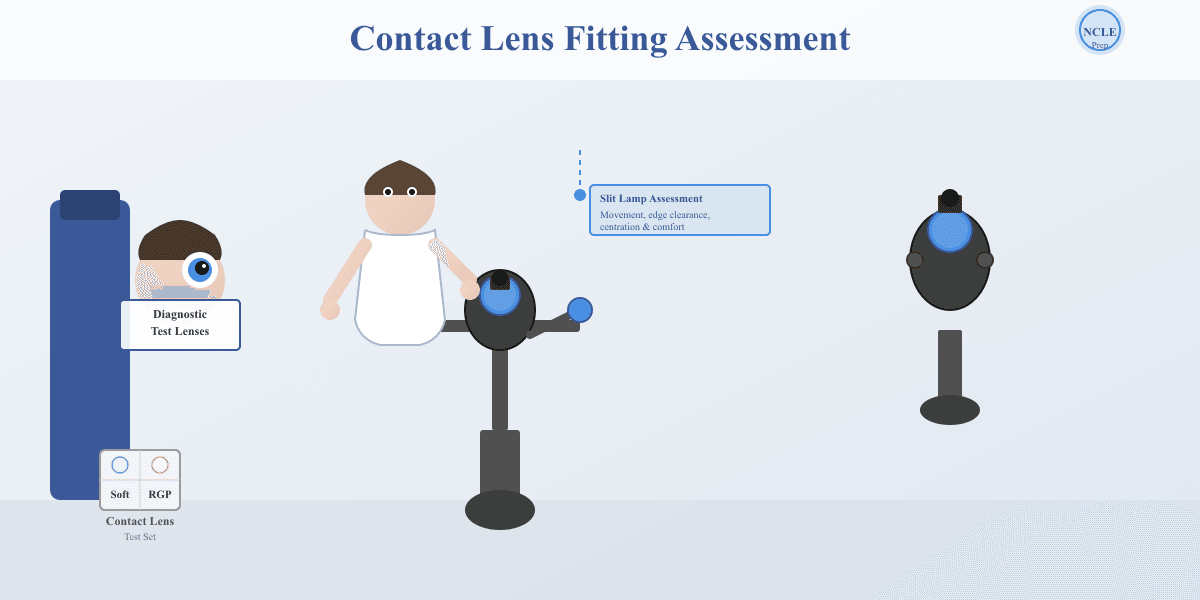
Overview: What Contact Lens Fitting Actually Means
Learning how to fit contact lenses as an optician is more than matching a prescription to a base curve. A successful fit balances optics, corneal shape, eyelid anatomy, tear film, material properties, wearing schedule, and patient comfort. For NCLE preparation, think of fitting as a sequence: collect reliable pre-fitting data, select a diagnostic lens using the manufacturer's guide, allow it to settle, evaluate it on the eye, perform an over-refraction, and make only evidence-based changes.
In practice, contact lenses are prescribed and managed according to state law, practice protocols, and manufacturer labeling. This guide is educational and supports exam preparation; it does not replace a comprehensive eye examination, diagnostic fitting, or clinical judgment by a qualified eye-care professional.
Pre-Fitting Assessment
Begin with history. Ask about the patient's visual tasks, previous lens experience, replacement habits, wearing time, occupational environment, cosmetics, allergies, medications, and dryness or allergy symptoms. Clarify whether the goal is daily wear, occasional sports use, monovision, multifocal correction, or correction of astigmatism. The preferred modality must suit both the eye and the patient's ability to follow lens-care instructions.
Record the current spectacle refraction and visual acuity, then assess ocular health before fitting. Observe lids, lashes, conjunctiva, cornea, and tear film with the slit lamp. Significant staining, active inflammation, infection, uncontrolled dry eye, or poor hygiene behavior should be addressed before routine lens wear proceeds. Evaluate pupil size and binocular vision when the intended design or visual complaint makes those findings relevant.
Corneal curvature measurements are a useful starting point, particularly for RGP fitting. A keratometer measures the curvature of the central anterior cornea and helps identify corneal toricity. Remember its limitation: a keratometer does not measure the entire corneal shape or directly determine sagittal depth. Corneal topography provides more detailed shape information when indicated. Base curve, diameter, and lens design work together, so no single K reading "chooses" a lens.
Soft Lens Fitting
Select the initial soft diagnostic lens from the manufacturer's fitting guide using the prescription, corneal measurements, horizontal visible iris diameter, and clinical findings. Let the lens settle before judging it—often at least 10 to 15 minutes—then evaluate it in primary gaze and with eye movements. A successful soft lens is generally centered, provides complete corneal coverage with limbal coverage, moves slightly with the blink, and allows stable, clear vision.
Slight movement is expected. Many well-fitting soft lenses move approximately 0.2 to 0.4 mm with a blink, but this is a clinical reference rather than an independent pass-or-fail rule. Use the push-up test as another clue. A lens that is difficult to move superiorly, resists displacement, or recenters sluggishly may be too tight. A lens that displaces easily, decentrates, or takes too long to recenter may be too loose. Interpret these signs with comfort, vision, surface findings, and the particular lens design.
Do not reduce the fitting decision to "steeper" or "flatter" base curve alone. Increasing soft-lens diameter generally increases sagittal depth, and a smaller base-curve radius is steeper. Material modulus, edge design, thickness profile, and the individual corneal-scleral shape also change the fit. When a change is needed, use parameters available for that specific lens and verify the resulting fit on the eye.
RGP Lens Fitting
RGP fitting is judged primarily by the fluorescein pattern between the posterior lens surface and the cornea. Apply fluorescein appropriately, view with cobalt-blue illumination and a yellow barrier filter, and assess the central, midperipheral, and edge relationships. An ideal pattern is usually described as an alignment relationship: neither excessive central bearing nor excessive central pooling, with appropriate peripheral clearance and edge lift for tear exchange and comfort.
A lens fitted too flat tends to show central bearing and excessive edge clearance. It can decenter, move excessively, feel noticeable, and cause unstable vision. A steep lens tends toward central pooling, reduced peripheral clearance, reduced movement, and possible adherence after settling. It may show midperipheral bearing depending on the lens and corneal shape. A typical corneal RGP often moves about 1 to 2 mm with a blink, but lid attachment, diameter, fitting philosophy, and corneal condition matter.
After establishing a satisfactory relationship, check centration, movement, comfort, acuity, and over-refraction. High spectacle powers may require appropriate vertex consideration when converting to contact lens power. Confirm the final ordered lens with the manufacturer's parameters and dispensing verification process.
Toric and Specialty Lens Considerations
Soft Toric Lenses
A toric lens must provide both a healthy fit and stable rotational orientation. Allow the lens to settle, then observe the manufacturer's orientation marks. Record the direction and amount of rotation consistently; do not compensate for intermittent or unstable rotation until the cause is understood. If rotation is stable, use LARS for axis compensation: Left Add, Right Subtract. Reassess orientation, over-refraction, and vision with the compensated trial lens.
Specialty Designs
Multifocal fitting requires real-world assessment: distance vision, near vision at the patient's working distance, lighting, pupil behavior, and the patient's priority tasks. Corneal GP toric, hybrid, and scleral designs require design-specific evaluation. Scleral lenses vault the cornea and land on the conjunctiva, so assess central and limbal clearance, haptic alignment, settling, and blanching or impingement. Follow the selected manufacturer's fitting guide; specialty lens fitting is not safely reduced to a generic base-curve rule.
Materials Selection
Material choice affects oxygen delivery, comfort, deposits, replacement schedule, and care requirements. For soft lenses, oxygen transmissibility is expressed as Dk/t: material oxygen permeability divided by lens thickness. A material with a high Dk does not automatically produce the highest Dk/t if the lens is thicker in the relevant zone. Silicone hydrogel lenses generally provide higher oxygen transmissibility than conventional hydrogel lenses, but surface wettability, modulus, lens care, and patient tolerance still matter.
RGP materials are oxygen-permeable and provide crisp optics, durable surfaces, and a tear lens that can mask some regular corneal astigmatism. They may be especially useful for higher astigmatism, irregular corneas, and patients who need stable optics. However, adaptation, lens awareness, lid interaction, and deposits must be managed. Choose the modality and material for the eye, the prescription, the intended schedule, and the patient's likelihood of successful wear—not simply for a single marketing specification.
Fit Assessment Techniques
A complete assessment combines objective observations with the patient's experience. Check visual acuity and perform an over-refraction after the lens has settled. Observe centration, movement with blink and versions, coverage, lens surface wetting, deposits, and toric orientation when applicable. With the slit lamp, inspect the limbus, conjunctiva, and cornea. After lens removal, evaluate for staining, indentation, injection, edema, or other tissue changes.
Fluorescein is central to RGP assessment. Soft lenses can absorb fluorescein, which can obscure interpretation and discolor the lens; evaluate corneal staining after removal using appropriate sterile, single-use fluorescein and clinical technique. Document the trial lens brand, power, base curve, diameter, material, orientation, over-refraction, acuity, fit observations, and plan. Good documentation makes the next adjustment logical instead of guesswork.
Troubleshooting Common Fit Problems
Safety First
Pain, photophobia, marked redness, discharge, or reduced vision are not routine "fit adjustments." The lens should be removed and the patient should receive prompt evaluation from an eye-care professional.
For a soft lens that appears tight, look for minimal movement, difficult push-up, sluggish recentering, suction on removal, or conjunctival indentation. A lower-sag option—such as a flatter base curve or smaller diameter when available—may help, but reassess the entire fit. For a loose soft lens, excessive movement, decentration, edge awareness, and fluctuating vision may indicate the need for a higher-sag option, such as a steeper base curve or larger diameter.
Dryness and variable vision are not always a base-curve problem. Check the tear film, lens surface, deposits, replacement compliance, solution compatibility, environmental exposure, and incomplete blinking. For RGPs, use the fluorescein pattern to separate a central-bear/flat relationship from a central-pool/steep relationship, then adjust the parameter that addresses the observed issue. Never troubleshoot in isolation: comfort, vision, movement, centration, and ocular physiology must agree.
NCLE Study Tip
Practice answering fitting questions in order: identify the finding, explain what it means, choose the parameter change, and state what you would recheck. For a comprehensive exam plan, use our NCLE study guide and NCLE exam study strategy.
Frequently Asked Questions
How much movement should a soft contact lens have?
A well-fitting soft lens commonly shows slight movement with a blink, often about 0.2 to 0.4 mm. It should center well, cover the cornea and limbus, and move enough to avoid a suction-tight fit. Judge movement together with comfort, vision, centration, push-up response, and slit-lamp findings rather than treating one number as universal.
What fluorescein pattern suggests a steep RGP lens fit?
A steep RGP fit typically shows central fluorescein pooling with relatively reduced edge clearance and less lens movement. It may adhere or feel tight after settling. Confirm the full pattern, including the midperiphery and edge, because corneal shape, lens diameter, and lid interaction all affect the appearance.
How do you adjust a toric contact lens that rotates?
First allow the lens to settle, then record the direction and amount of rotation from its manufacturer markings. For a stable, consistently rotating soft toric lens, use LARS when calculating the compensated axis: Left Add, Right Subtract. Recheck vision and orientation with the compensated trial lens.
What should a patient do if a contact lens causes pain or light sensitivity?
They should remove the lens and seek prompt evaluation from an eye-care professional, especially when pain, marked redness, photophobia, discharge, or reduced vision is present. These symptoms can indicate a sight-threatening problem and should not be managed by changing lens parameters or continuing wear.